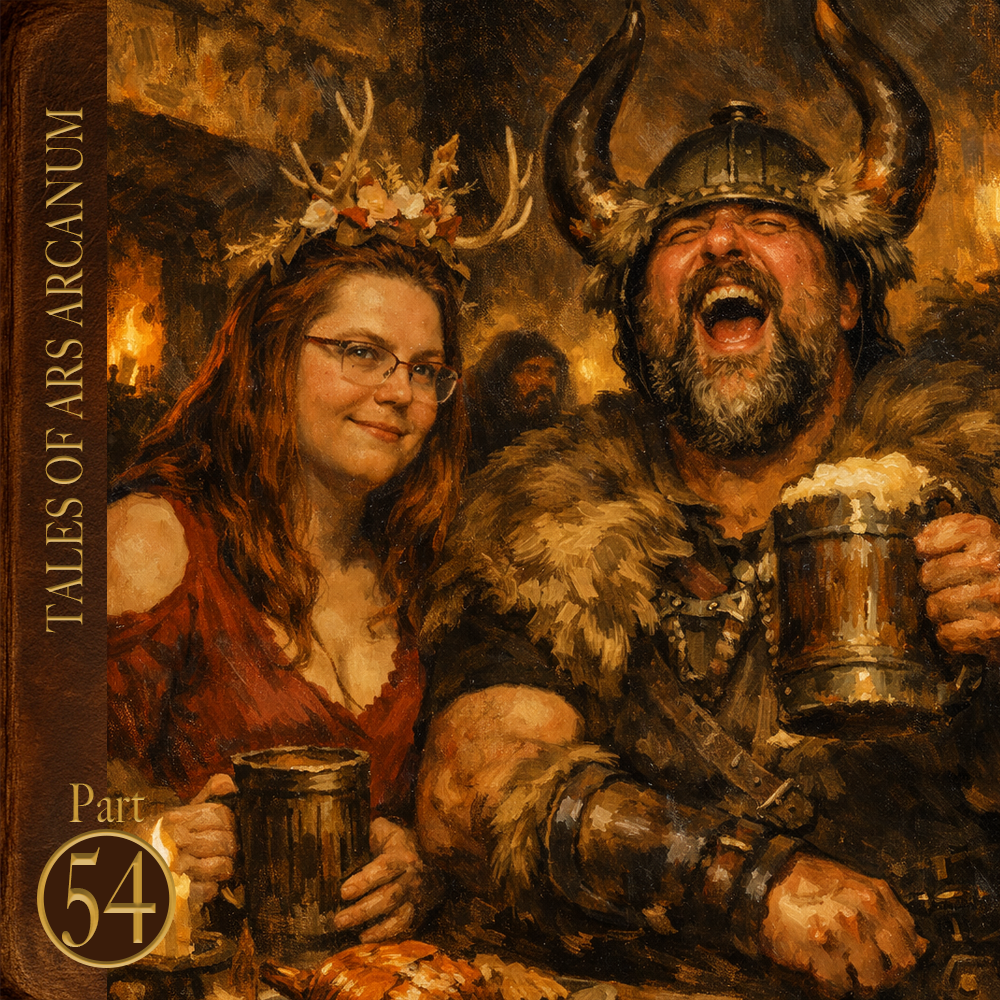
The tavern known as The Screaming Dragon has a reputation. Not for good food, cleanliness, or polite conversation, but for its unrivaled ability to make even the darkest soul forget their troubles long enough to be run out the door with their coin purse missing.
On a storm-soaked evening, Jung Todesburg, bruiser, barbarian, and sworn enemy of bad ale, stomped barefoot across mud that would make a kobold weep. His greatsword Thunder’s Apology swung across his back like it was still hungry for breakfast. Jung’s sister Gerta marched beside him, eyes narrowed with that particular familial exasperation that meant she was already regretting this trip.
“We did not come all this way for fermented swamp water,” Gerta growled, brushing rain from her impeccable braids.
“Bull guts,” Jung replied through a beard that could shelter a pixie. “They said here the ale was ‘robust’ and robust is practically a battle cry.”
Lightning split the sky as they crossed the threshold. The hearth’s warmth flickered over puddles on the stone floor. A barmaid skidded past with a tray of mugs, nearly colliding with a figure perched on a stool. She holds a flute that gleamed too warmly to be honest metal, smooth yet restless, as if something moved beneath its skin.
That figure looked up, eyes glowing with amused curiosity. Cheryl Doomflute, her dark hair wild, with whistles tucked into her belt like ill-tempered pets, clustered too close together. One knocked sharply against another as she shifted, a faint, complaining chime, as though they resented the flute for getting all the attention.
Jung barely steps inside before his expression tightens.
The Screaming Dragon smells like smoke, damp wool, old wood, and bodies packed too close together – nothing unusual. Then something else cuts through it. Something sharp, acrid, and out of place. His stride slows without him meaning it to.
Gerta bumps his shoulder as she slips past. “Why the face?” she asks. “You’ve been talking about the Dragon’s ale for weeks. We’re finally here.”
Jung doesn’t answer right away. His gaze drifts, unfocused, tracing the bar, the hands, the mugs. “It’s lively,” he says at last.
“That’s good,” Gerta says. “That’s what we came for.”
Jung’s jaw works. “Someone’s fouled a drink.”
Gerta exhales through her nose, already scanning for empty stools.
At the bar, a man with too many rings and a small round tattoo on his hand, laughs too loud at nothing in particular. His friends lean in. Jung watches the man’s hand; how it lingers, how it shields itself as a vial tips, just barely, into a mug that isn’t his. The liquid disappears without a ripple, swallowed clean by foam.
Jung’s fingers curl.
He stares at the mug as if it has been insulted, something honest, tampered with. His attention sharpens, not on the man’s face, but on the beer itself. The tragic beer, ruined before it ever reaches a mouth.
He shifts his weight, eyes narrowing, and the room feels suddenly smaller.
The music from the forgotten flute player sharpens. Not louder, but harsher, as if it had split into the shrieks of three banshees at once. The tone threads itself between tables, needling. The man glances toward her, annoyed.
He stands. His friends snicker. One of them nudges the mug toward a woman who is too busy laughing hysterically and gesturing wildly at a friend to notice that her drink has moved.
Jung opens his mouth. Closes it. He looks to Gerta instead. “Someone is poisoning the beer.”
Gerta sniffs the air, unimpressed. “I smell ale and desperation. You always think—”
His eyes track the mug. The woman reaches for it, and he moves.
He bumps the table hard, sloshing the drink. “Oops,” he says sweetly, in a voice hardly recognizable as his own. “Careful there, dove. This place over pours. You don’t want that on an empty stomach.”
The woman thanks him, distracted and bleary-eyed, before turning back to her now subdued friends. Crisis delayed, but the energy in the room has shifted.
The man with the rings freezes, then scowls down at the beer now dripping off the edge of the table. His eyes flick from the puddle to Jung’s boots, then past him to the hearth, then across the room, finally landing on the musician who has gone still.
“Nothing to see here,” he says, too loudly, as if daring the words to make it true. “Keep playing.”
The flute player regards him in the still and silent room, her head tilting just slightly to the left in curiosity. The same distant interest a blade might show flesh before it learns its shape.
“You should go,” she says.
He laughs, sharp and defensive. “With you?” and deliberately turns his back in dismissal.
He reaches for the mug Jung spilled, fingers hooking the handle. Then, reconsidering, he snatches a fresh one from the bar instead, sloshing it carelessly as he turns, liquid arcing close enough to kiss another patron’s sleeve.
A few people flinch, but no one speaks.
That’s when Cheryl plays.
One note, short and dense. It hits the man like his lungs forgot how to be lungs. He staggers, eyes wide, beer spraying uselessly as his body folds around nothing. He collapses, choking, already dying.
The Screaming Dragon explodes into noise.
Chairs scrape. Someone screams. The man’s friends reach for knives.
Jung is already moving. He plants himself between Doomflute and the room, grinning like this is the best night he’s had in months. His fists start flying; a cheekbone and a table break. He laughs, full and bright, like a child on a merry-go-round.
Cheryl lifts the flute again, but she does not turn it on the other men. The sound goes wide instead, pressing outward with a gentle reverberation. Fear dissipates as people lower their weapons. Calm spreads across the crowd and subdued conversation resumes.
Jung feels it immediately, the way the room exhales around him. He shifts his stance but does not lower his guard.
People in the room hesitate, eyes drifting not to Jung, but to the body on the floor and to the woman with the flute who is no longer playing. Someone drags a stool back. Someone else discreetly leaves. The noise drains out of the Screaming Dragon, leaving only the fire and the rain and the body in a puddle of fluid on the floor.
The man’s friends gather him in awkward silence. One of them hooks an arm under the corpse’s shoulders, his sleeve riding up as muscle strains. A round mark shows on his bicep, dark ink warped by movement. No one tries to stop them.
They haul the body toward the door, the noise of their boots scraping loud in the quiet crowd. The door opens briefly letting in the noise of the storm. When the door shuts again, the Screaming Dragon moves once more, like a construct waiting for a command. Familiar motions click back into place, but somewhat disjointed, without warmth or life.
Jung turns to Cheryl, still buzzing. “You protect the room,” his voice booms out, delighted. “I protect you.”
She looks him over and grins. “Deal.”
Gerta rubs at her left temple. “I can’t leave you alone for five minutes.”
Cheryl wipes her flute and starts to stow it away. One of the whistles knocks lightly against her hip, petulant, protesting being ignored. She looks at Jung out of the corner of her eye and remarks, “I don’t stay long in places that remember me.”
Jung shrugs. “You could come with us.” He says it the way he says most true things, without ceremony or expectation. The offer lingers between them.
Cheryl studies the door, the storm clawing at it, the blood cooling on the floor behind her. Her fingers brush the flute case beside her, thoughtful, though she says nothing as she considers.
Outside, thunder rolls on, distant and unsettled, as if the night itself is waiting to see what happens.
_____________
Originally published as “A Stormy Night at the Screaming Dragon” by M.S. Dirgewood. Gripping Yarns & Fabrications, Early June 1975.
_____________
AI was used to create this post’s image but not the story, and never our music or album art.
No responses yet